The Lesvos Ledger
Explore Lesvos
Discover the hidden gems of Lesvos — from ancient ruins and thermal springs to picturesque villages and stunning beaches.
Discover the hidden gems of Lesvos — from ancient ruins and thermal springs to picturesque villages and stunning beaches.
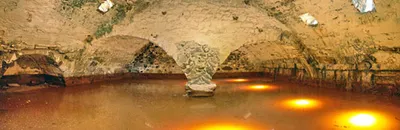
Natural thermal springs on the Gulf of Yera, in use since antiquity — a temple to Hera is believed to have stood here, and the Romans bathed here too. The Ottomans knew the site as "Sarlitza," the yellow baths. The mineral-rich water reaches nearly 47°C and is traditionally used to ease rheumatism, arthritis, and skin conditions. Eleven individual bathtubs are just steps from Paradisos Studios.
Open in Google Maps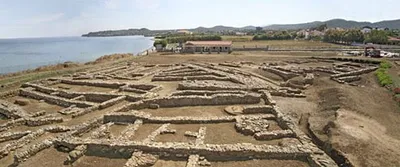
A 5,000-year-old Early Bronze Age settlement (3200–2400 BC) on the shore at nearby Pyrgoi, among the earliest examples of organized town planning in the Mediterranean. Excavated by British archaeologist Winifred Lamb in 1929–1933 and reopened to visitors in 2008, it was home to roughly 1,200 people at its peak across five successive building phases.
Open in Google Maps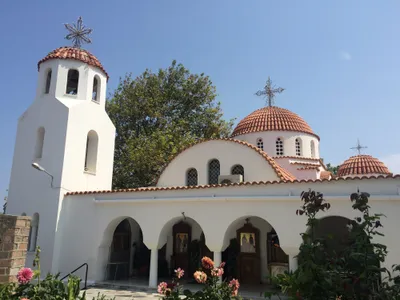
One of the most important pilgrimage sites in Greece, built in 1963 on the ruins of an older monastery where the monk Raphael and his companions Nicholas and Irene were martyred by Ottoman soldiers in 1463. Canonized in 1970, the saints are venerated by thousands of pilgrims each year, especially on Bright Tuesday after Orthodox Easter.
Open in Google Maps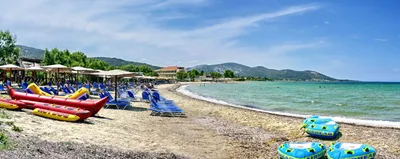
A Blue Flag sand-and-pebble beach in Pyrgi Thermis, just a few hundred meters long with shallow, gently sloping water ideal for families with young children. Organized with sun loungers, beach bars, and tavernas right along the shore, it sits alongside the thermal baths that give Thermi its name.
Open in Google Maps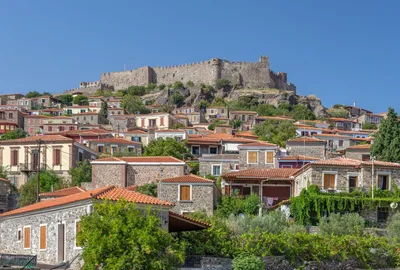
A picture-perfect village on the northern coast, crowned by a Byzantine-Genoese castle first fortified in the 6th century and rebuilt in 1373 — the last stronghold on Lesvos to fall to the Ottomans, in 1462. Cobbled lanes wind past stone mansions down to a harbor lined with tavernas, with sweeping Aegean views from the castle walls.
Open in Google Maps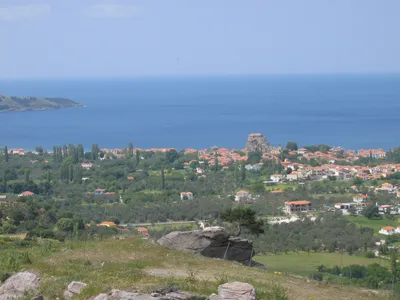
A charming seaside village 5km past Molivos, famous for the 17th-century Church of Panagia Glykofilousa perched atop a 40-metre volcanic rock — reached by climbing 114 stone steps for one of the best sunset views on the island. Legend tells of a captain who found a lost icon of the Virgin Mary glowing at the summit.
Open in Google Maps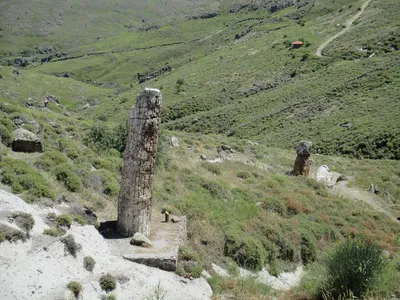
One of the world's most significant fossilized forests, formed 17–20 million years ago when volcanic eruptions buried an entire subtropical forest in ash and lava, preserving trunks, roots, and leaf imprints in remarkable detail. Protected across roughly 15,000 hectares near Sigri, Eressos, and Antissa, it forms the core of the Lesvos UNESCO Global Geopark. The Natural History Museum in Sigri is the best starting point, with several open-air parks nearby — well worth the drive across the island.
Open in Google Maps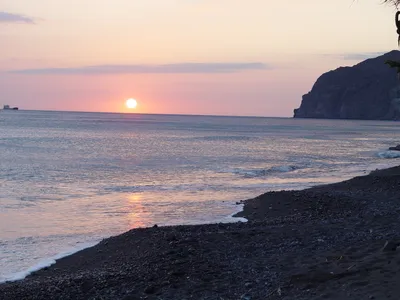
The birthplace of the ancient lyric poet Sappho, whose 7th-century-BC verses gave us the word "sapphic." A scenic 4km path through mulberry and plane trees links the hillside village of Eresos to its coastal counterpart, Skala Eresou, with one of the longest sandy beaches on Lesvos and a famously laid-back, artistic atmosphere. Well worth the trip across the island for the beach alone.
Open in Google Maps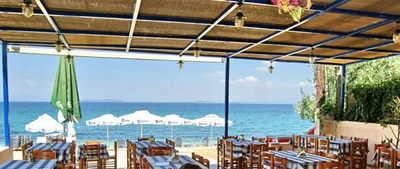
Picturesque fish taverns and cafés line the little harbor of Thermi, a short walk from Paradisos Studios. Sit by the water over grilled octopus, fresh catch of the day, and a glass of ouzo — the classic way to spend a warm Lesvos evening, with the thermal baths and Kanoni beach both nearby.
Open in Google Maps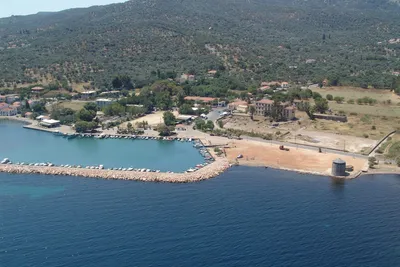
Pyrgoi takes its name from the striking three-storey stone tower houses built here from the late 18th century onward — summer retreats for wealthy Mytilene families that doubled as refuges from pirate raids. By the late 1800s, around 160 of these tower mansions stood in the area, the largest concentration on the island.
Open in Google Maps